
Resident ownership is one of the most durable ways households build long-term financial security.
Yet most housing finance systems were not designed to support resident ownership at scale.
This work addresses structural barriers that prevent resident ownership models from scaling.
Why affordability erodes
Public investment—through subsidy, zoning, infrastructure, and tax policy—creates long-term land value. Without durable ownership and governance structures, that value transfers out of community stewardship and is captured privately.
Time-limited affordability resets both price and control. When capital exit occurs without aligned governance authority, permanent affordability erodes.
Durability requires structural alignment between ownership, governance authority, and capital exit.
Ownership determines where value accumulates
Since the early 1980s, household wealth in the United States has increasingly concentrated at the top. Ownership structure determines whether value compounds in a small number of hands or circulates locally.
Concentrated ownership extracts value from communities. Distributed and locally governed ownership allows that value to circulate within the local economy.
Permanent resale restrictions, enforceable stewardship, and defined governance authority prevent long-term value extraction.
Locally retained value supports housing stability, small business continuity, and predictable public tax bases.
How resident ownership changes incentives
Conventional rental housing separates responsibility from authority. Residents maintain homes they do not control, while long-term decision rights and value sit elsewhere.
Resident ownership realigns responsibility with authority. Households participate in governance, hold defined ownership interests, and share in equity within structured affordability limits.
Durability depends on enforceable decision rights—not voluntary compliance.
Why governance determines durability
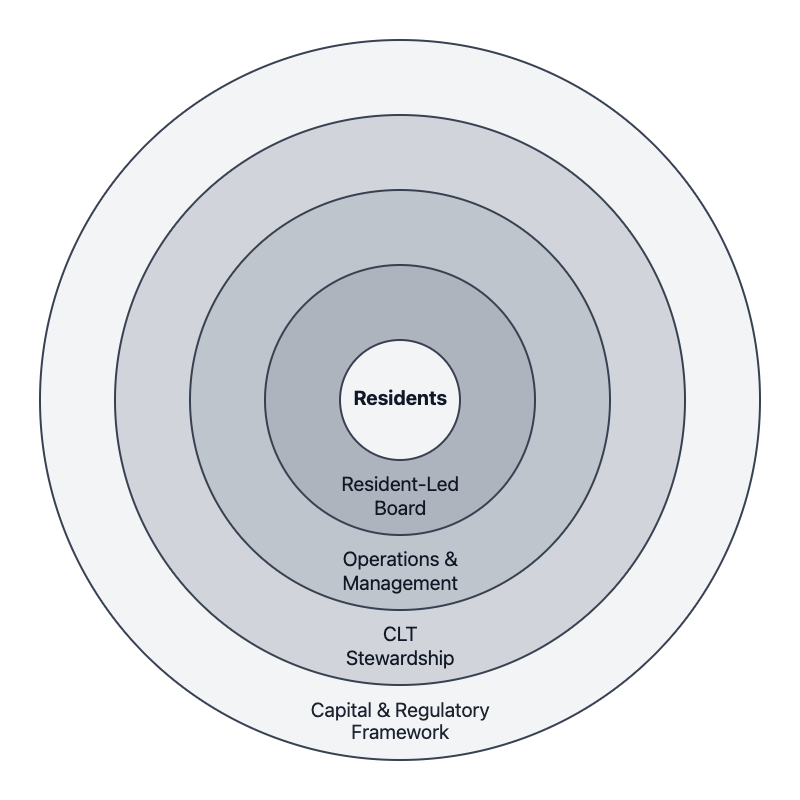
Ownership alone does not ensure long-term affordability. Governance defines how ownership functions under real conditions.
Durable governance structures:
- Clarify decision rights and responsibilities
- Enforce affordability and resale terms
- Allocate authority between residents and institutions
- Persist through refinancing and leadership transition
When governance authority is embedded in recorded documents, affordability survives refinancing and capital turnover.
Why Community Land Trusts are often used
Community land trusts (CLTs) are a proven institutional infrastructure for long-term land stewardship.
By separating land stewardship from capital exit, CLTs reduce:
• Speculative capture
• Recapitalization pressure
• Governance drift
• Public subsidy erosion
In many Pathway to Equity structures, a CLT is designed to hold land in permanent stewardship. In smaller-scale or context-specific projects, equivalent recorded stewardship mechanisms may be used where forming a separate CLT entity is impractical.
Structure—not subsidy alone—creates long-term affordability.